About Verizon Business: Four Decades of US Commercial Telecom
Verizon Business is the commercial division of Verizon Communications Inc. (NYSE: VZ) and the largest US wireless carrier by subscribers serving organisations. The brand operates the nationwide wireless network, the 230,000+ route-mile fiber backbone and the voice and cloud stack that power 1.5 million US business customers — from single-site SMBs to every Fortune 500 company, the full US federal government and 44,000+ public-safety agencies.
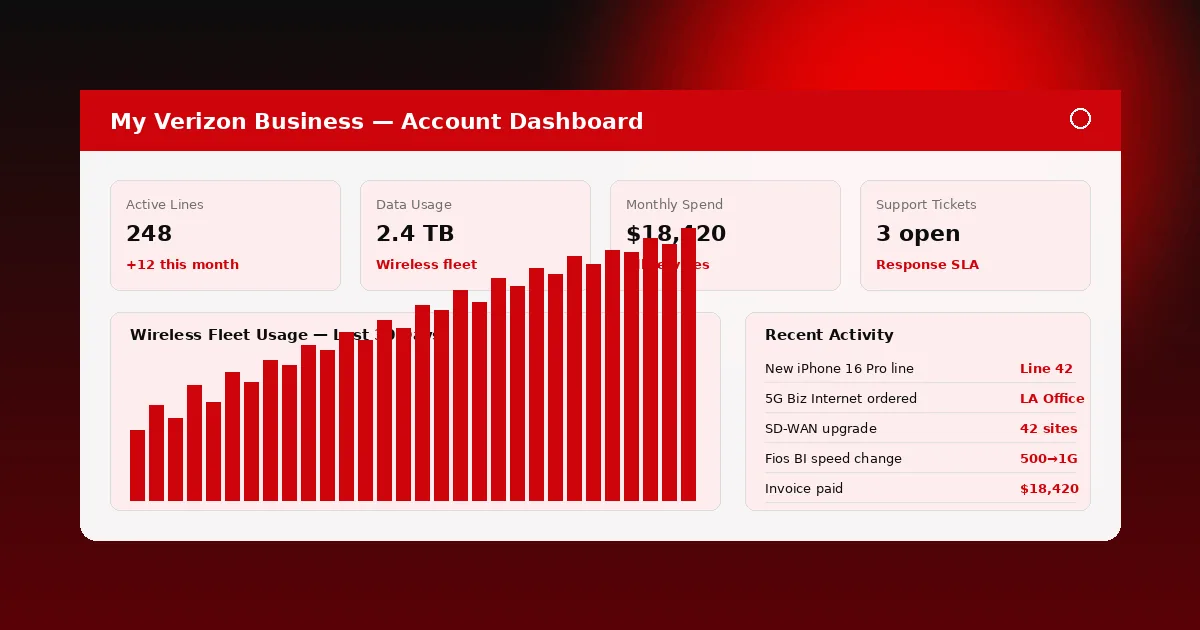
Our mission: deliver resilient, secure, measurable connectivity through a single authenticated portal. Every product in the Verizon Business catalogue — wireless, Fios fiber, 5G Business Internet, VoIP, SD-WAN, Private 5G, IoT — is administered through My Verizon Business, the self-service commercial console.
Executive Findings
- Heritage: Verizon Business descends from the 1984 Bell System divestiture (Bell Atlantic, NYNEX), the 2006 MCI acquisition and the 2020 consolidation into a single commercial brand.
- Scale: 1.5M+ US business customers, 99% US population wireless coverage, 230K+ US fiber route miles, global IP backbone reaching 150+ countries.
- Mission: Single-portal administration of wireless, fiber, 5G, voice and cloud through My Verizon Business with enterprise SLAs and role-based delegation.
- Public sector: Dedicated federal, state, local and education practices plus Verizon Frontline priority network access for first responders.
- Parent: Verizon Communications Inc. (NYSE: VZ), Dow Jones Industrial Average component, headquartered at 1095 Avenue of the Americas, New York, NY with operations HQ in Basking Ridge, NJ.
Heritage: From Bell Atlantic to Verizon Business
The Verizon Business brand is the consolidation of four decades of US commercial telecom lineage under a single commercial banner.
The modern Verizon Business traces back to the 1984 Bell System divestiture, when the US Department of Justice consent decree broke AT&T into seven Regional Bell Operating Companies. Two of those RBOCs — Bell Atlantic and NYNEX — covered the Northeast and Mid-Atlantic states and would later merge in 1997 to form Bell Atlantic Corporation. The merged entity acquired GTE in 2000 and the combined company was renamed Verizon Communications Inc. on June 30, 2000, with dual headquarters in New York, NY and Basking Ridge, NJ.
Verizon's commercial business ambitions expanded decisively with the 2006 acquisition of MCI Inc. — the long-distance and enterprise network carrier that had itself absorbed WorldCom's operating assets after the 2002 bankruptcy. The MCI acquisition added a global IP backbone, enterprise-grade MPLS and long-haul fiber to the Verizon portfolio, and the combined commercial unit was branded Verizon Business from 2006 to 2011. A 2011 reorganisation folded the unit into Verizon Enterprise Solutions Group (VESG) while retail wireless business was marketed separately as Verizon Wireless Business.
The contemporary commercial brand came together in 2020, when Verizon reunified VESG, Verizon Wireless Business and the Small & Medium Business group under a single operating division called Verizon Business. Tami Erwin led the division through launch; Sowmyanarayan "Sampath" Sampath succeeded her as CEO of Verizon Business in 2023. This consolidation put wireless, fiber, 5G, voice and professional services under one P&L and — operationally — behind one authenticated portal: My Verizon Business.
The 2021 completion of Verizon's Tracfone acquisition added prepaid wireless reach for SMB resellers, and the ongoing C-Band 5G buildout funded by the 2021 spectrum auction (where Verizon invested $45.4 billion for mid-band licences) quadrupled the 5G Ultra Wideband footprint that underpins 5G Business Internet coverage today. On the collaboration side, the BlueJeans video conferencing platform acquired in 2020 was wound down in 2024 as Verizon Business pivoted its UC stack toward Webex Calling and Microsoft Teams Direct Routing partnerships.
| Year | Milestone | Impact on Verizon Business |
|---|---|---|
| 1984 | Bell System divestiture creates Bell Atlantic & NYNEX | Regional wireline and wireless assets that become Verizon's Northeast core |
| 2000 | Bell Atlantic + GTE form Verizon Communications | Nationwide wireline footprint; commercial telecom brand born |
| 2006 | MCI acquisition completes | Global IP backbone and enterprise network reach added; first "Verizon Business" brand use |
| 2011 | Reorganised as Verizon Enterprise Solutions Group | Enterprise-first go-to-market model and dedicated account teams |
| 2020 | Unified "Verizon Business" division launches | Wireless, fiber, 5G, voice and SMB consolidated under one leader and one portal |
| 2023 | Sampath appointed CEO, Verizon Business | Doubling down on SMB digitisation, Private 5G and managed services |
Scale: What 1.5M+ US Business Customers Looks Like
Verizon Business scale rests on three pillars: wireless coverage, fiber footprint and global IP reach.
99% US Population Coverage
Verizon's wireless network reaches 99% of the US population across 4G LTE and 5G Ultra Wideband according to FCC Broadband Deployment reports. Every one of those cell sites is available to Verizon Business commercial plans on equal footing with consumer plans, with commercial-grade administrative controls through My Verizon Business.
230K+ US Fiber Route Miles
The Verizon wireline backbone includes more than 230,000 route miles of US fiber, supporting Fios Business Internet in the Northeast, Mid-Atlantic and selected metros plus long-haul Ethernet, wavelengths and MPLS transport for enterprise clients nationwide.
150+ Country Global IP Backbone
Inherited from MCI, Verizon's Tier 1 global IP backbone terminates in more than 150 countries with owned cable landings in 21 countries. This underpins international connectivity for US-headquartered enterprises and multinationals with US footprints.
Who Verizon Business Serves
From two-line startups to every Fortune 500 company, Verizon Business segments the US commercial market across four bands.
Small & Medium Business (1–499 lines)
Over 1.4 million of Verizon Business's 1.5M+ customer base sits in the SMB segment. This band gets self-service wireless plans, Fios Business and 5G Business Internet with 10-year price guarantee, VoIP phone systems and bundled security through a lightweight portal experience inside My Verizon Business.
Mid-Market & Enterprise (500–10,000+ lines)
Mid-market and enterprise accounts get dedicated relationship managers, priority service desks, custom SLAs and access to professional services — SD-WAN design, Private 5G deployment, managed security and contact centre programs. Administrative workload scales through the hierarchical multi-location Verizon Business portal.
Global Enterprise & Wholesale
Multinationals headquartered or operating in the US consume MCI-heritage global MPLS, international private line, internet transit, DDoS mitigation and managed SD-WAN through Verizon's owned global IP backbone. Wholesale customers (MVNOs, cable carriers, cloud providers) purchase capacity, transit and interconnect at scale.
Public Sector & Verizon Frontline
A dedicated Verizon Public Sector practice covers federal civilian agencies, DoD, state and local governments, and K-12 and higher education. Verizon Frontline delivers priority network access, push-to-talk radios, mobile command units and satellite backhaul to more than 44,000 US public-safety agencies — fire, police, EMS and emergency management. Compliance frameworks align with NIST guidance and federal acquisition rules.
Product Philosophy: One Portal, Every Line
Verizon Business runs on a deliberately opinionated product philosophy: every commercial service is administered through one authenticated portal. A wireless line, a fiber circuit, a 5G router, a VoIP seat and an SD-WAN overlay are not separate accounts with separate logins — they are separate rows in the same My Verizon Business workspace, connected to one billing stack, one permission model and one audit log.
That single-portal philosophy informs how the company invests in engineering. Device provisioning, circuit activation, user administration, invoicing, analytics and support case creation all ship through the same authenticated APIs and the same role-based access control. This is what makes the difference between a consumer carrier that also sells to businesses and a commercial-first operator. Every pricing plan, every compliance control, every SLA is designed around the multi-user, multi-location, multi-entity reality of US business buyers. For administrators, this reduces ticket volume; for CFOs, it simplifies month-end close; for CISOs, it concentrates logging and access review in a single surface area.