Contact Us

Verizon Business Portal: The Admin Dashboard for US Commercial Clients

The Verizon Business portal is the admin dashboard US commercial clients use to manage wireless, fiber, 5G, voice and cloud services. The Verizon Business portal runs in Chrome, Edge, Firefox and Safari, with a native My Biz App on iOS and Android. Enterprise tiers add SSO with Okta, Azure AD and Ping, IP allowlisting, API access and longer audit log retention.

This page covers the architecture of the Verizon Business portal — browser support, session management, role delegation, SSO, API capabilities and the mobile-vs-web parity matrix. For the account workspace behind the portal, see the Verizon Business online account page.

Sign In Portal Interface Overview
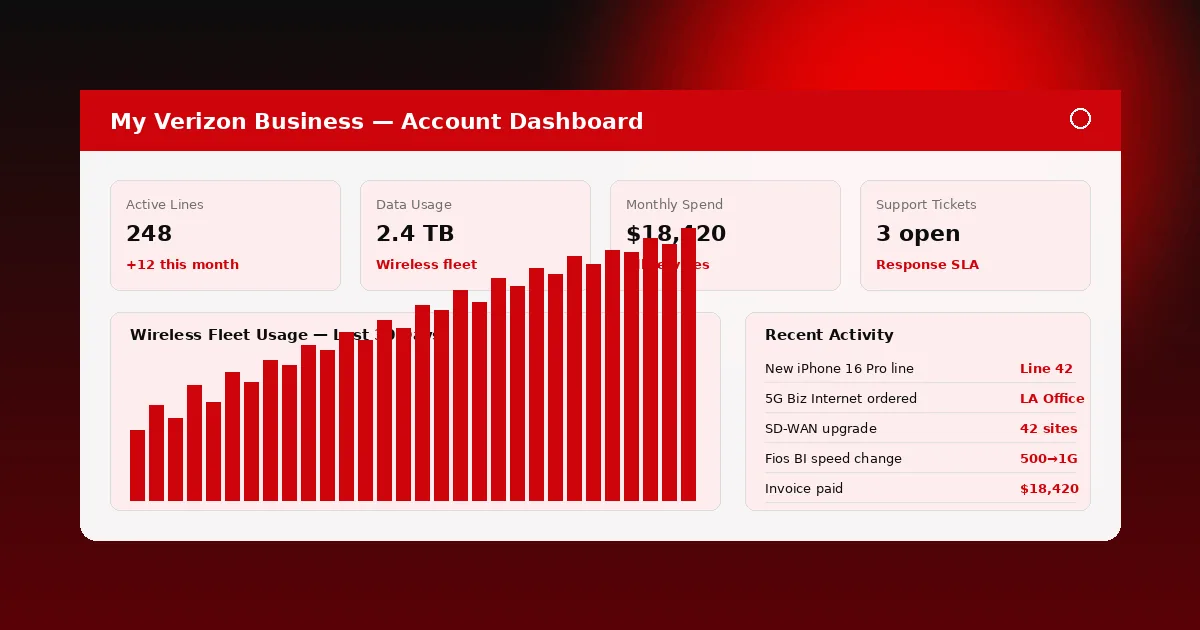
Verizon Business portal admin dashboard with SSO-enforced sign-in, role delegation matrix, API tokens and audit log panel

Portal Mechanics: Architecture of the Verizon Business Portal

The Verizon Business portal is built for two classes of admin — the small-business owner who signs in from a browser bookmark, and the enterprise security team that enforces SSO, IP allowlisting and SIEM-streamed audit logs. Same portal, different posture.

Browser Support and TLS Baseline

The Verizon Business portal supports current versions of Chrome, Edge, Firefox and Safari. TLS 1.2 or higher required. JavaScript enabled and third-party cookies allowed for verizonbusiness.at. Internet Explorer is not supported; organisations still on IE need to move before portal access works.

Session Management

Idle session timeout defaults to 30 minutes; security admins can reduce to 15 minutes at the Enterprise tier. Session cookies are Secure, HttpOnly, SameSite=Lax. Concurrent session limits configurable. MFA re-challenge on high-risk actions (payment method change, admin role grants) in the Verizon Business portal.

IP Allowlisting

Enterprise tenants can restrict Verizon Business portal access to named IP ranges — corporate egress, VPN exits, specific AWS VPCs. Allowlist applies at authentication and at every API call. Break-glass bypass available to named security officers on a timed basis.

Audit Log Retention

Admin actions, authentication events, configuration changes and billing transactions log to an immutable audit trail. 13-month default retention; Enterprise tier extends to 7 years. Exports as JSON or CSV. Stream to client SIEM via the admin API in the Verizon Business portal.

Verizon Business Portal Capability Matrix

Where each capability works — browser, mobile app, API and enterprise SSO.

Portal CapabilityBrowserMobile AppAPIEnterprise SSOAudit Logged
Billing and InvoicesFullFullRead/ExportYesYes
Device Line ManagementFullFullRead/WriteYesYes
Usage Analytics ReportsFullView-onlyRead/ExportYesRead log
Role Delegation (RBAC)FullView-onlyRead/WriteSCIM syncYes
Support CasesFullFullCreate/ReadYesYes
Service Upgrades & E-SignFullView-onlyRead onlyYesYes

Verizon Business Portal at a Glance

The numbers behind portal scale and security posture.

4Supported Browsers
3Certified SSO Providers
13 moDefault Audit Retention
7 yrEnterprise Audit Retention

Feature Brief: SSO, API and Access Delegation Inside the Verizon Business Portal

Enterprise tenants layer security controls on top of the baseline Verizon Business portal — SAML SSO, SCIM user provisioning, OAuth 2.0 API tokens and IP allowlisting.

SSO with Okta, Azure AD and Ping

SAML 2.0 single sign-on into the Verizon Business portal ships certified integrations with Okta, Microsoft Entra ID (Azure AD) and Ping Identity. Any SAML 2.0 compliant IdP also works. Configuration is self-service inside the portal — upload the IdP metadata XML, configure attribute mappings, test sign-in flow, enforce SSO-only after testing.

SCIM 2.0 provisioning syncs user creation, role changes and deactivation from the IdP to the Verizon Business portal in near real time. Offboard a user in Workday, they lose portal access within minutes without manual intervention. Break-glass service accounts remain available to the security team for IdP outages.
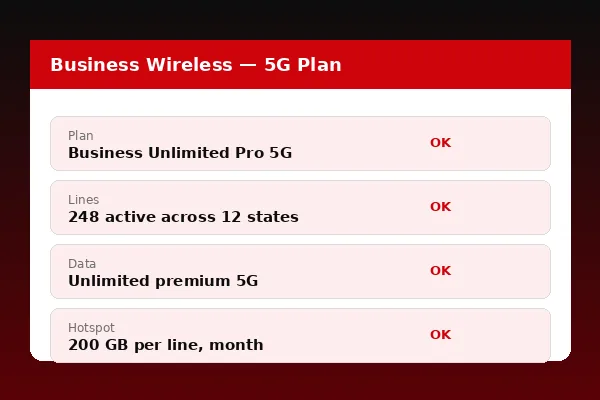
Verizon Business portal SAML SSO configuration with Okta metadata upload, attribute mapping and SCIM provisioning enabled
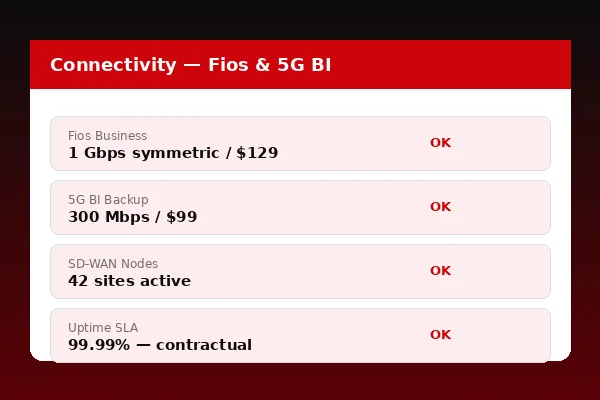
Verizon Business portal REST API with OAuth 2.0 client credentials, IP allowlisting and nightly usage pull for ERP integration

API Access for ERP Integration

The Verizon Business portal exposes a REST API covering line management, usage analytics, billing retrieval, support case creation and SSO configuration. OAuth 2.0 client credentials issued from the admin console. IP allowlisting enforced at the API edge. Rate limits scale with contract tier. Typical integrations pull nightly usage and billing feeds into SAP, Oracle EBS or Dynamics 365 ERP.

Webhooks notify external systems of billing events, line-inventory changes and support-case state transitions. Webhook signing with HMAC-SHA256. Replay protection via timestamp validation. The Verizon Business portal API follows NIST cybersecurity framework authentication guidance.

Mobile Parity and Desktop Escalation

The My Biz App on iOS and Android reaches full parity with the Verizon Business portal web interface for billing, device line management and support cases. Reports are view-only on mobile — exports run on desktop. RBAC role definition, SSO configuration and service-upgrade e-signature are web-only; the mobile app surfaces a deep-link that jumps into the browser context with session preserved.

Every session — mobile or web — lands in the Verizon Business portal audit log. Device fingerprinting, IP origin, MFA method and action taken all captured. Audit entries are immutable; retention runs 13 months by default, extending to 7 years at the Enterprise tier. Stream events to a client SIEM (Splunk, Chronicle, Sentinel, Elastic) via the admin API.

Verizon Business portal mobile and desktop parity with My Biz App iOS and Android matching most web workflows

Voices From Verizon Business Portal Admins

"SCIM Ended Manual Offboarding"

"We had orphaned Verizon Business portal accounts for months after people left. SCIM sync from Okta now deactivates portal access inside two minutes of Workday termination. Compliance stopped flagging the gap."

— Kim L., Identity Lead, Highcastle Insurance (Phoenix, AZ)

"IP Allowlist Locked Down Access"

"Security mandated Verizon Business portal reach only from corporate egress IPs. Allowlist configuration took 10 minutes. Nothing outside the ranges authenticates any more. Break-glass covers the three of us who travel."

— Terrance W., CISO, Vanguard Industrial (Pittsburgh, PA)

"API Integration Pulled Bills Into SAP"

"Nightly pull from the Verizon Business portal API into SAP replaced four hours of manual CSV work per month. OAuth 2.0 client credentials, IP allowlisted to our data centre VPC. Billing reconciliation runs automated now."

— Anita R., ERP Manager, Brickworks Manufacturing (Charlotte, NC)

Verizon Business Portal FAQs

What is the Verizon Business portal?
The admin dashboard US commercial clients use to manage wireless, fiber, 5G, voice and cloud services.
Which browsers are supported?
Current Chrome, Edge, Firefox, Safari with TLS 1.2+. No Internet Explorer.
Does it support SSO?
Yes — SAML 2.0 with Okta, Azure AD, Ping and any compliant IdP. SCIM provisioning included.
What audit retention applies?
13 months default; 7 years at Enterprise tier. JSON/CSV export; SIEM streaming via API.
Does the portal expose an API?
Yes — REST API with OAuth 2.0 and IP allowlisting. Covers lines, usage, billing, support cases, SSO config.

Commercial Telecom Portal — Topic Cluster